
📘 CCNA 200-301 v1.1
1.3 Compare Physical Interface and Cabling Types
1.3.a – Single-mode fiber, Multimode fiber, Copper
Network communication depends on physical cables that connect devices such as routers, switches, servers, and end-user computers.
In CCNA, you must understand the three main types of physical media:
- Single-mode fiber (SMF)
- Multimode fiber (MMF)
- Copper cables (Twisted-pair cables like Ethernet cables)
Each cable type is designed for different distances, speeds, and environments. Let’s explain each in detail.
1. Single-Mode Fiber (SMF)
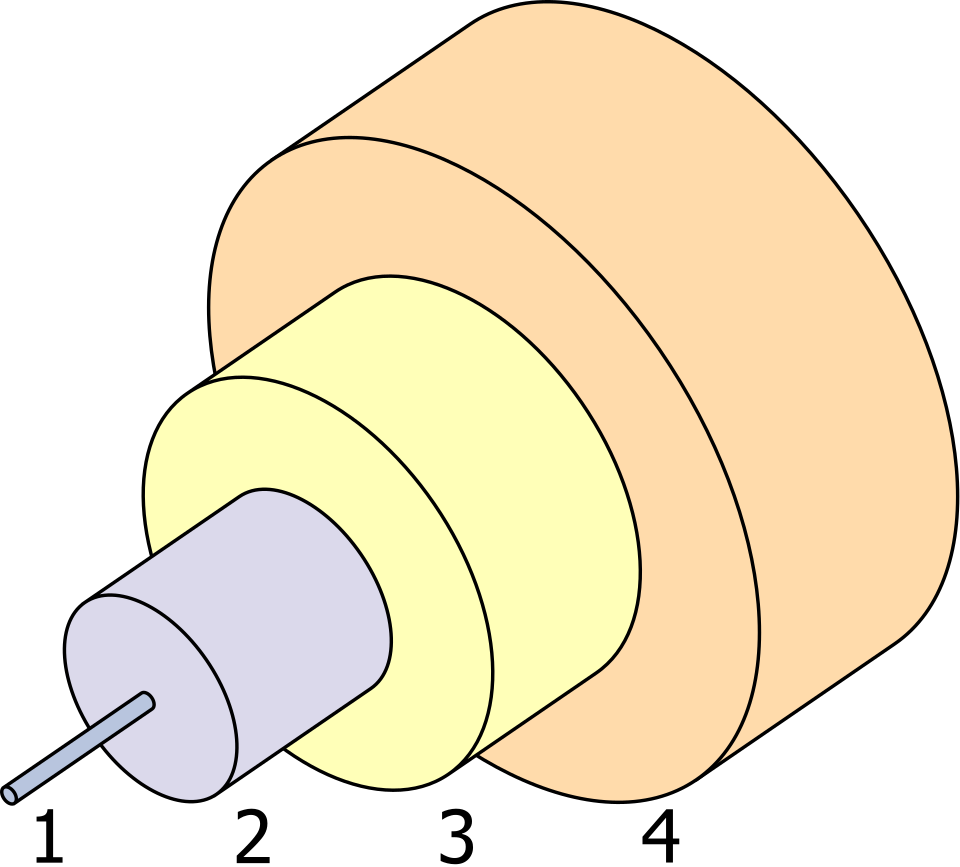
1. Core 8–9 μm diameter
2. Cladding 125 μm diameter
3.Buffer 250 μm diameter
4. Jacket 900 μm diameter
By Original by Bob Mellish, SVG derivative by Benchill – derivative work by uploader, CC BY-SA 3.0, https://commons.wikimedia.org/w/index
Definition:
Single-mode fiber uses a very thin glass core (about 9 microns in diameter) that allows only one light signal (mode) to travel through the cable.
Key Points:
- Uses laser light as the light source (because lasers are focused and powerful).
- Designed for long-distance communication — often used in WANs, data centers, or between buildings.
- Provides very high bandwidth and low signal loss (attenuation).
Characteristics:
| Property | Description |
|---|---|
| Core size | ~9 microns |
| Light source | Laser |
| Distance range | Up to 40 km or more (depending on equipment) |
| Speed | 1 Gbps, 10 Gbps, 40 Gbps, 100 Gbps, and beyond |
| Color of jacket (outer cover) | Yellow (for identification) |
| Cost | More expensive than MMF (laser-based transceivers are costly) |
Usage Example in IT:
- Connecting two core switches between data centers several kilometers apart.
- Internet Service Providers (ISPs) use SMF to link their main network backbone connections.
2. Multimode Fiber (MMF)
Definition:
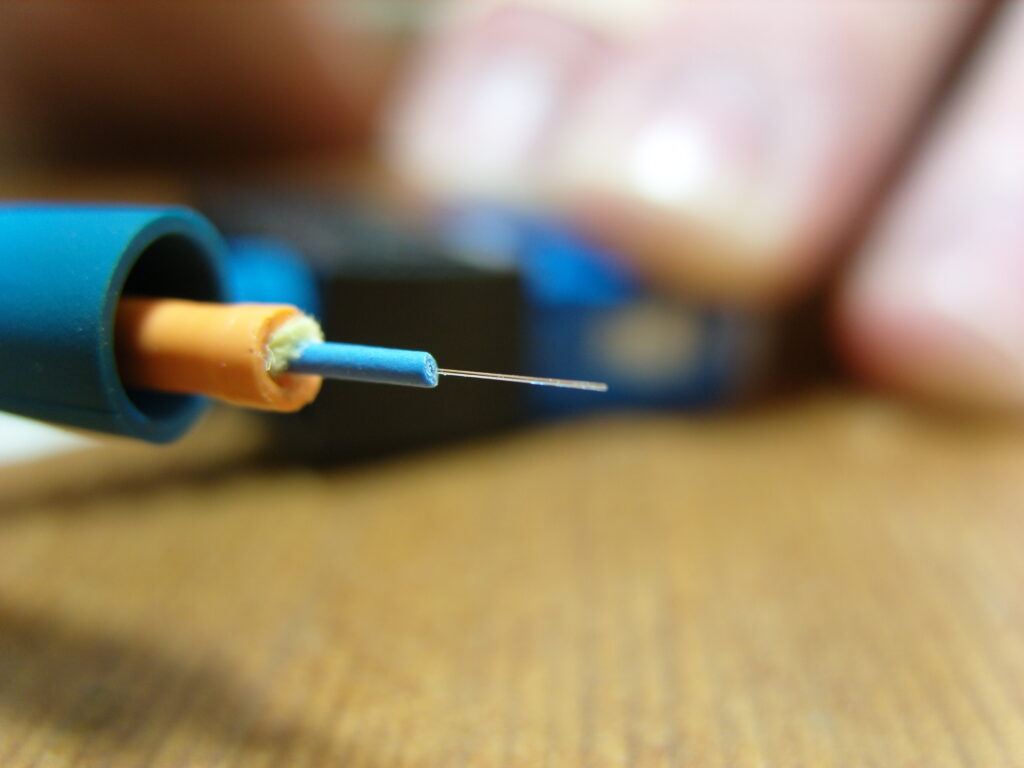
By Original by Bob Mellish, SVG derivative by Benchill – derivative work by uploader, CC BY-SA 3.0, https://commons.wikimedia.org/w/index
Key Points:
- Uses LED light sources instead of lasers.
- Designed for shorter distances — typically within a building or campus.
- Multiple light paths (modes) can cause signal dispersion, meaning the light signals spread out and lose clarity over longer distances.
Characteristics:
| Property | Description |
|---|---|
| Core size | 50 or 62.5 microns |
| Light source | LED |
| Distance range | Up to 550 meters (depending on standard and speed) |
| Speed | 1 Gbps, 10 Gbps, 40 Gbps (short-range) |
| Color of jacket | Orange (OM1/OM2) or Aqua (OM3/OM4) |
| Cost | Cheaper than SMF (LED equipment is cheaper) |
Usage Example in IT:
- Connecting switches in the same building (for example, between floors).
- Server rooms and local data centers where high speed is needed but distance is limited.
3. Copper Cables (Twisted-Pair Ethernet Cables)
Definition:
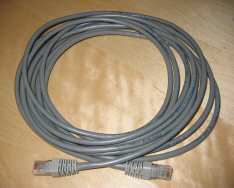
Copper cables use electrical signals (not light) to transmit data through pairs of twisted copper wires.
Key Points:
- Used for short-distance connections, such as connecting computers to switches or switches to routers.
- Most common type in LAN environments.
- Twisting helps reduce electromagnetic interference (EMI) from nearby cables or devices.
Main Types of Twisted-Pair Cables:
| Type | Full Name | Shielding | Typical Use | Max Distance |
|---|---|---|---|---|
| UTP | Unshielded Twisted Pair | No shielding | Office networks, general use | 100 meters |
| STP | Shielded Twisted Pair | Has foil/braided shielding | High-interference environments | 100 meters |
| S/FTP | Shielded/Foiled Twisted Pair | Extra shielding per pair | Data centers, sensitive equipment | 100 meters |
Cable Categories (Ethernet Standards):
| Category | Speed | Max Distance | Common Use |
|---|---|---|---|
| Cat5e | Up to 1 Gbps | 100 m | Common in small offices |
| Cat6 | Up to 10 Gbps (short distance ~55m) | 100 m | Modern LANs |
| Cat6a | 10 Gbps | 100 m | High-speed networks, data centers |
| Cat7/Cat8 | 40 Gbps (short distance) | 30–50 m | Specialized or backbone cabling |
Connector Type:
- RJ-45 connector is used at the ends of copper Ethernet cables.
Color of Jacket:
- Varies (blue, gray, yellow, etc.) — no standard color like fiber optic cables.
4. Comparing the Three Cable Types
| Feature | Single-Mode Fiber | Multimode Fiber | Copper (Twisted Pair) |
|---|---|---|---|
| Medium | Glass | Glass | Copper wire |
| Signal type | Light (Laser) | Light (LED) | Electrical |
| Distance | Long (up to 40 km+) | Medium (up to 550 m) | Short (up to 100 m) |
| Bandwidth | Very High | High | Limited |
| Interference | Immune | Immune | Prone to EMI |
| Cost | Expensive | Moderate | Cheap |
| Common Use | WAN links, long-distance connections | LAN or campus backbone | End-user connections, LAN |
| Connector | LC or SC | LC or SC | RJ-45 |
5. Connectors Used in Fiber Optic Cables
| Connector | Description |
|---|---|
| LC (Lucent Connector) | Small form factor; common in modern networks |
| SC (Subscriber Connector) | Push-pull design; older but still in use |
| ST (Straight Tip) | Used in older fiber systems (twist-and-lock style) |
For CCNA exam purposes, remember LC and SC are most common today.
6. Key Points to Remember for the Exam
- Single-mode fiber = Laser, long distance, small core (9 µm), yellow cable.
- Multimode fiber = LED, short distance, large core (50/62.5 µm), orange or aqua cable.
- Copper = Electrical signals, short range (up to 100 m), uses RJ-45 connectors.
- Fiber = immune to EMI, Copper = affected by EMI.
- SMF used in WAN or backbone, MMF used in LAN/campus, Copper used for end devices.
- Know cable categories (Cat5e, Cat6, Cat6a) and maximum speeds/distances.
✅ Summary for CCNA 200-301
| Media Type | Medium | Signal Type | Typical Use | Distance | Connector |
|---|---|---|---|---|---|
| SMF | Glass (9 µm) | Laser | Long-distance WAN or backbone | Up to 40 km+ | LC/SC |
| MMF | Glass (50/62.5 µm) | LED | Short-distance LAN/campus | Up to 550 m | LC/SC |
| Copper | Twisted copper wires | Electrical | Device-to-switch connections | Up to 100 m | RJ-45 |
